
Chapter 1 – Early Childhood
Chapter One: Sunshine Girl
I arrived in the early hours of the morning 1:55 AM on 24 November 1984 at Mowbray Maternity Hospital in Cape Town, South Africa. My parents named me Andrea, and I joined my brother Ryan, who was two years old, already loud and adventurous.

My mother fell into postnatal depression not long after I was born. The exhaustion of managing a newborn and a spirited toddler became too much. Within eighteen months, she had moved out. In an unusual ruling for the time, custody went to my father, William McIntosh.
My earliest memories are of my dad – and they’re happy ones. He called me his Sunshine Girl. And I believed him.
We lived at 26 Donkin Avenue, Table View. From the outside, it looked like paradise. Palm trees lining a brick driveway, a neat grass garden, a wooden four-bedroom house behind a security gate.
Our days had a rhythm. Morning cartoons, Jungle Oats porridge or toasted egg sandwiches for breakfast, then daycare. In Winter, we huddled in the backseat of the car on winter mornings while it warmed up, squealing as Dad sprayed down the windows with the hosepipe. It felt magical, like snow. And somehow this mundane little moment became one of my favourites. After work, he’d pick us up, and we’d eat dinner while watching cartoons – Tom and Jerry, The Smurfs, My Little Ponies. If we were lucky, we’d stay up late to watch MacGyver. On weekends, we visited friends who had kids, drove through the dunes in Dad’s Jeep, or played Pictionary with the neighbours. Sometimes we’d spend the day at Big Bay, or visit our grandparents in Durbanville.
I loved those visits, my Oupa, a former WWII navigator in the British Air Force, told stories that made my eyes go wide. Ouma always smelled of baking and wore soft knits. She gardened, cooked, crocheted, and made her home feel magical. They bred and trained German Shepherds, and I’d lie down on their thick coats, cuddling their giant heads in my lap.
Despite my dad’s short temper, he was devoted to us. Strict, yes, but also fun. We all slept in the main bedroom back then, Dad in the middle, with our dogs, his Pitbull and Rottweiler, curled up by the door. They were gentle giants. When I turned four, he bought me a white Whippet, probably as a bribe to get me to sleep in my own bed. I named her Snowy. She became my shadow. She could leap like a gazelle, and we played hide and seek for hours. It was the beginning of a lifelong love for dogs. Their loyalty never betrayed me.
My dad had this charming cheesiness about him. He adored making people smile. Valentine’s Day meant heart balloons tied to his car and floating candles in the pool. Our garden bloomed all year with colourful flowers and multi-coloured fairy lights. He played Tina Turner and Michael Bolton through outdoor speakers like it was a love story to the world. I absolutely get my hippie-dorkiness from him – and my explosive temper too.
But something darker brewed in the silences…


Ryan, my big brother, was my world. He was fun and fast and fierce. But around the time I turned four, he began to change. His energy shifted – subtly, at first. Our playfights turned harder. His affection became conditional. There were days he was my best friend. And then there were days he hated me with a coldness I couldn’t name.
We still saw our mother often, but my memories of her then are fragmented—brief snapshots: visiting her in Pinelands when she stayed with her parents after the divorce, walking through Company Gardens to feed squirrels when she lived in a flat in Gardens – The “Tampon Towers,” as locals called them. She married Ossi, our dad’s former boss, in a grand wedding at the Mount Nelson Hotel in 1988. I was the flower girl in a princess dress. We started staying with them some weekends at their home in Camps Bay. It was big and luxurious, with wide views and ocean air.

But every Sunday exchange between parents was like a tiny heartbreak. You’re too young to make sense of the emotional whiplash. You love both. You want peace. Instead, we were caught in a war neither of them would stop fighting. They bad-mouthed each other endlessly, dragging us into it. I didn’t know who to believe.
One weekend, I returned from my dad’s with a vaginal infection. My mom was convinced something terrible had happened. She interrogated me for hours, desperate for a confession. It turned out to be a simple reaction to bubble bath, but the trust between my body and the adults meant to protect it had already begun to fracture.
And then one day, everything changed.
I was sitting in Dad’s leather armchair, playing solitaire on his computer. He was in the garden watering plants. I felt hands on my shoulders. Gentle. Then not. They slipped down toward my chest. I wriggled, uncomfortable. The hands grew firmer. I jumped up. Turned.
Ryan.
He grinned crookedly and ran from the room.
I must’ve been four or five. It started with him cupping my chest. It escalated. Soon it was his hands inside my pants. If I resisted, he hurt me – pressed hard on my wrists, choked me, backhanded my throat. If I escaped, he’d punish me with silence or cruelty. Eat my cereal. Snap my Barbies. Kick Snowy. Isolate me. Humiliate me. But if I didn’t fight him, he could be kind again. Play Mario. Share toys. Let me ride bikes with him and his friends.
It created a twisted logic: compliance brought love.
I became hyper-aware. Memorizing people’s footsteps. Locking doors. Avoiding any moment we might be alone. I lived in constant vigilance, terrified and ashamed. Why didn’t I tell anyone? I used to ask myself this a lot.
When your abuser is your brother – the boy you once adored, someone who you thought was your protector – the shame is bone-deep. The shame becomes cellular. Especially when the hands touching you are the same hands that once held yours across the road.
We were sent to a child psychologist named Rigsby during our parents’ custody battle in 1990. My mother won custody. We moved into a new home they’d built – Number 9 Nettleton Road, Clifton. It was a mansion. It even had a lift. Everything about my world changed overnight. New home. New school. New siblings. New life.
Except one thing.
Ryan’s violence escalated. His cruelty became relentless. He’d sit outside my door chanting, “Andi’s a pea brain, ha ha,” for hours. Recorded it on cassette, just to torment me while he did something else. When I tried to swim, he tried to drown me. On roller skates? He tripped me. He threw things. Pinched. Punched. Whatever he could get away with. I started hiding. Sometimes I’d run away—not far, just long enough to feel gone. But no one ever noticed. That made it worse.
I had my first ‘boyfriend’ at seven, but I ran away from his house one night because I thought he might hurt me too. I rollerbladed halfway home in the dark, sobbing by the time Ossi found me. I couldn’t ask for help – I didn’t know how. I lied and said a man at the soccer field had touched me. My mom saw through it.
When I was eight, I started riding horses in Hout Bay.
My first ride was on a pony named Lightning, who decided that day to fall madly in love with a nearby mare. It was chaos ! and I was hooked. Soon I was leasing a bay pony with a stripe named Snuggles. Grumpy as hell but the best jumper at the yard. I would bribe the grooms to catch and saddle him for me, and in return, he gave me the one thing I couldn’t find anywhere else: joy.
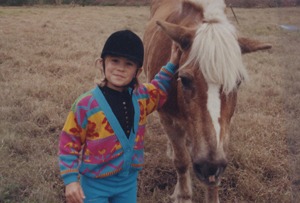
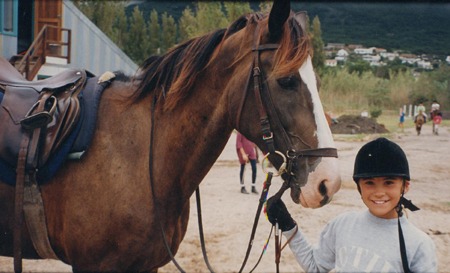
Horses saved me.
They were freedom. Power. Connection. The world dropped away the moment I mounted up. Wind in my face, hooves pounding sand, that deep, sacred bond between girl and horse. No one could hurt me when I rode.
Except the ground!
At ten, we moved to Longleat, a smallholding in Hout Bay. My mother had been offered a horse by a new friend – a tall chestnut gelding named Jumbo. Without knowing anything about owning horses, we plunged in. And I got a pony of my own: Melody. A dapple grey mare with a wild heart and more sass than a teenage girl. She was untrained, headstrong, and absolutely perfect. I adored her.
I’d sneak out at night just to check if she was lying down. Spent hours watching her graze. Outrides in the forest. Canters on the beach. I didn’t know then that horses were rewiring my nervous system, showing me safety through rhythm and trust.
That year, Snowy died. I cried every day after school. She had been my rock for many years.
A few weeks later, our Border Collie, Badger, mated with another nearby, and for my 11th birthday, I was given a tiny fluffball puppy in a box with a red ribbon. I called him Shadow. He followed me everywhere. Another piece of magic. Another lifeline.
But Ryan hadn’t stopped.
And one night, he tried to sneak into my room through the balcony. I slammed the door on his foot, and he threw a Coke can at my face. The sharp edge split my upper lip right through to my teeth. It was one of the very few times there was visible proof.
Ossi lost it. Belt off. Rage ignited. Him and I were very close and when he was around, I was untouchable.
My mother intervened, horrified.
They fought all night while I sat on my bed crying, lip bleeding, full of guilt. I wished I’d just let Ryan do what he wanted. Then none of this would’ve happened. That night was the beginning of a pattern I’d carry into adulthood: Avoid conflict at all costs, even my own.
I begged my mom for years to protect me from his bullying. “It’s just sibling rivalry,” she’d say. “He’ll grow out of it.” Sometimes she’d tell me stories about her own brother. Sometimes she bought me gifts. But she never stopped it. I never told her about the sexual abuse. I couldn’t. That’s how abuse works. It convinces you that your suffering is less harmful than the truth.
Eventually, it ended. I don’t know why. Maybe he got a girlfriend. Maybe something else shifted.
But by then, the damage had been done.
And my body remembered everything.
Trauma doesn’t vanish. It waits in your nervous system. It shows up in how you flinch at raised voices. In how your heart races when someone walks too close behind you. In your fear of being believed. In your need to people-please. It lives in your body long after the bruises heal.

You May Also Like

Walking Blackwater River at sunset

Chapter 5 – A mother’s destruction
